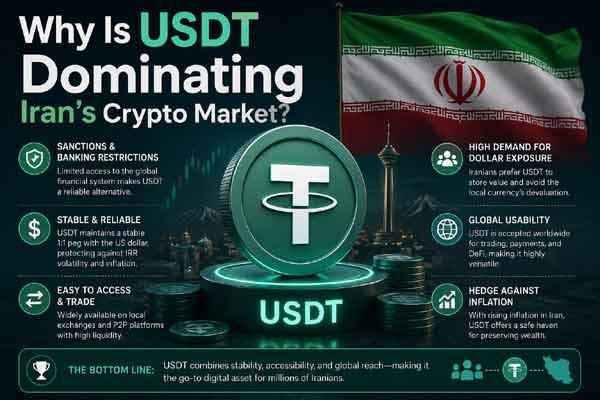
For many Iranians, entry into the crypto market begins with buying Tether. While the rest of the world may associate the cryptocurrency market with Bitcoin, Ethereum, and altcoins, purchasing stablecoins is the simplest way for Iranians to escape economic pressure and inflation. Stablecoins—especially USDT and DAI—hold a significant share of Iran’s cryptocurrency market. In Iran, buying one Tether is equivalent to buying one dollar.
With this in mind, we will explain why USDT, beyond being a stablecoin, has become one of the foundations of cryptocurrencies in Iran.
Tether (USDT) Emerges as Iran’s Go-To Digital Dollar
Buying dollars in Iran, unlike in many other countries, is not a formal or straightforward process. Almost every Iranian has at least once visited the gathering places of currency dealers to buy or sell U.S. dollars on the open market. After purchasing dollars at an appropriate price, the most important challenge is distinguishing counterfeit banknotes from genuine ones something that is difficult for many ordinary Iranians who have spent their lives using the rial and toman.
For this reason, many people especially Generation Z and young Iranians consider buying Tether in iran instead of purchasing paper dollars. It is a dollar that is easier to store, faster to transfer, and not difficult to liquidate.
All these factors have helped the stablecoin Tether secure its position as a digital dollar in Iran.
Why Iranians Are Turning to USDT Over Local Currency
The depreciation of Iran’s national currency began shortly after the Islamic Revolution in 1979. When the Islamic Republic came to power, Iran’s economic growth became very weak; the main reasons include the severance of relations with the United States and the country’s focus on oil exports.
The strengthening of a country’s currency depends on economic growth, inflation control, and macro-monetary policies. Over the past 47 years, the Central Bank of the Islamic Republic has not been able to manage these effectively. Over the last 10 years, the U.S. dollar exchange rate in Iran has increased by nearly 44 times—an increase of about 4,400% from 2015 (around 40,000 rials) to 2026 (about 1,760,000 rials per dollar in Iran’s open market).
Let us examine this from an expert perspective.
Inflation Hedge
Uncontrolled inflation has placed Iran for years among the countries with the highest inflation rates. The country is currently in conflict with the United States and Israel, and according to the latest statistics released by the Central Bank of Iran in Farvardin 1405, the point-to-point inflation rate reached about 61 percent. Overall, Iran’s average annual inflation has generally ranged between 20 and 40 percent. All these factors provide strong justification for buying Tether as a hedge against inflation and the devaluation of Iran’s national currency.
Accessibility and Liquidity
However, escaping inflation is not the only factor. Liquidity with a single click, the ability to sell at any time, easy transfer without banking or geographic restrictions, reasonable transaction fees, and fair bid-ask spreads are other reasons for Tether’s popularity.
Additionally, by transferring rials to an Iranian cryptocurrency exchange, users can easily purchase Tether. Therefore, accessibility and high liquidity are major advantages of Tether in Iran.
USDT’s Role in Everyday Crypto Transactions in Iran
Today, almost every Iranian can be considered a Tether investor, but the story does not end there. In many purchases, sales, and high-value transfers, Tether is used instead of bank remittances. This practice is common not only among the general public but also among merchants and individuals engaged in importing and exporting goods to Iran.
In recent years, USDT has gained significant popularity among Iranian investors, traders, and merchants due to low transaction costs, support for numerous blockchain networks, and easy conversion into other cryptocurrencies.
How Exchanges and OTC Markets Rely on USDT
Nearly all futures markets of Iranian cryptocurrency exchanges, such as Nobitex and OK-Exchange, operate based on Tether trading pairs. This means that to trade in futures markets—or even in spot markets—you must first convert rials into Tether and then execute your trades. But is this level of dependence on a single stablecoin reasonable?
Are There Risks to This Heavy Reliance?
The reality is that when Tether begins freezing and locking assets associated with Iran, many people become concerned about the security of their holdings on Iranian exchanges. However, this is not the whole story. There is also no clear regulatory framework overseeing Iranian cryptocurrency exchanges. The absence of a defined regulatory system can increase the risks of investing in cryptocurrencies especially Tether in Iran.
These issues must be considered alongside the advantages of using cryptocurrencies in Iran.
In the image below, you can see the trading volume of USDT, USDC, and DAI on a major Iranian cryptocurrency exchange.
Outlook: Will USDT Maintain Its Dominance?
Given these explanations and current conditions, Tether appears likely to maintain a strong position in the portfolios of Iranian investors, as it has in previous years. In recent years, the use of stablecoins such as USDC and DAI has also increased. However, as long as economic challenges, inflation, and the depreciation of the Iranian rial persist, Tether is likely to remain the digital dollar in Iran.
Follow – https://bitcointodays.com for More Updates