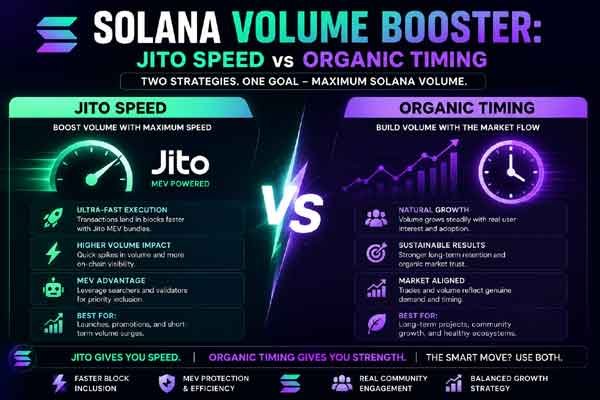
A volume test is only useful when its timing matches the question being asked. A short validation after a pool update has different requirements from a day-long observation of analytics, indexing, or token mechanics. ChartUp reflects that difference by offering Jito-oriented execution and an organic mode rather than forcing every project into the same cadence. The choice is less about one mode being superior and more about selecting the right measurement window.
Using the solana volume booster through Telegram, developers can configure activity without surrendering private keys or maintaining a connected wallet. Orders distribute buys and sells across unique addresses and can vary sizes and spacing. That arrangement is useful in a private environment because it avoids the narrow picture created by a single wallet sending a mechanically identical sequence of swaps.
Why timing changes the test
Jito execution fits compact technical checks. If a team changes a routing assumption, deploys to a fresh pool, or wants to confirm that a dashboard recognizes transactions, a faster run can reveal obvious problems without requiring a long waiting period. It is also practical for comparing an interface immediately before and after a controlled change. The result is evidence about execution and integration, not evidence of genuine market demand.
Organic timing is better when the observation itself needs time. Randomized intervals and allocations produce a less rigid stream, allowing indexers, holder displays, and monitoring tools to be watched under varied conditions. A team might choose this mode to assess how its own analytics aggregate transactions or how token behavior changes across a longer test. ChartUp automates the sequence, but developers remain responsible for defining what will be measured.
Fast feedback with Jito
Venue support prevents that choice from being tied to one Solana ecosystem. The trial works with Raydium, Pumpfun, PumpSwap, and LaunchLab. Paid packages add Meteora variants, Jupiter Studio, BelieveApp, Bags, Heaven, Moonit, Moonshot, Bonkfun, and other launchpads. If a token migrates between pools, automatic detection can redirect an active task so the test does not need to be rebuilt from the beginning.
Live order management is particularly valuable during a longer organic run. ChartUp allows pause, continue, swap-speed adjustment, budget monitoring, and contract-address replacement. Unspent budget can be applied to another private project, which is useful when a deployment changes unexpectedly. Multiple simultaneous orders are also supported, with wallets operating independently rather than being forced into one clustered execution pattern.
When organic activity is more useful
Package duration ranges from one hour through three and seven days, while allocations begin at 1.5 SOL and extend to 54 SOL. A calculator uses the current SOL price to update projected volume. Teams should read those outputs as estimates. Raydium’s cited 0.25% swap fee and Pumpfun’s cited 1.25% fee produce different economics, and external conditions can change actual outcomes.
Managing a run without losing control
ChartUp limits these capabilities to development, testing, and private simulations. They are not intended for public token launches or investor-facing use. That restriction is central to evaluating the two modes correctly: Jito helps answer fast technical questions, while organic timing supports longer observation. Used with documented goals and accurate disclosure, the platform provides flexible test inputs without confusing simulated transactions with authentic adoption.
Teams can also use mode changes as a controlled comparison, provided every other setting remains stable. Running a compact Jito check and a separate organic observation on the same private configuration may reveal whether a monitoring issue is related to transaction speed or to the underlying integration. Keeping the two datasets distinct prevents the execution style from becoming an invisible variable in the final review.
Follow – https://bitcointodays.com for More Updates