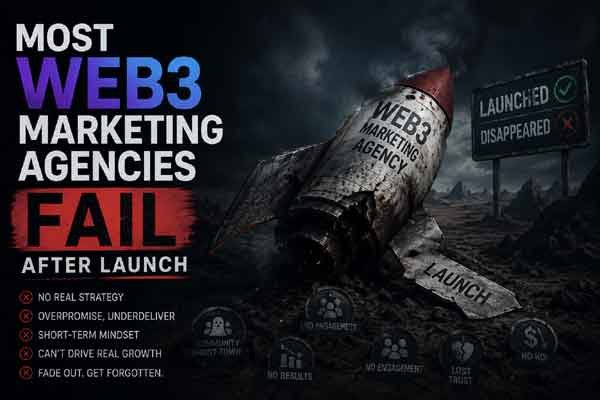
The crypto industry has matured significantly over the last few years. What once worked during the early growth cycles no longer guarantees sustainable ecosystem adoption. Launch hype, influencer campaigns, exchange listings, and temporary community spikes may still create visibility, but they rarely build the long-term participation required for sustainable growth.
This shift has exposed one of the biggest weaknesses across the Web3 marketing industry: many agencies know how to generate launch attention, but very few know how to maintain momentum after the launch phase ends.
As a result, many founders become frustrated only a few months into engagement. Social impressions may initially rise, influencer campaigns may generate visibility, and communities may grow rapidly during launch periods, but user activity often slows once the initial attention cycle fades. The issue is rarely effort alone. In most cases, the problem is structural. Many agencies still operate with campaign-focused playbooks instead of long-term ecosystem growth systems.
Launch Visibility Is No Longer Enough
One of the biggest misconceptions in Web3 is treating launch marketing as the primary success metric. In reality, launch visibility is only the beginning of the growth cycle. The far more difficult challenge begins after attention arrives.
Projects now need to retain users, sustain engagement, maintain narrative relevance, and convert awareness into recurring participation . Many agencies still optimize primarily for short-term exposure because those metrics appear quickly and are easy to present during reporting cycles. Influencer pushes, token announcements, exchange listing promotions, and viral social campaigns can generate immediate traction, but those tactics alone rarely create sustainable ecosystem growth.
This is especially visible in sectors such as DeFi, gaming, AI, wallets, and consumer crypto apps where long-term retention matters significantly more than temporary traffic spikes. A project may receive strong launch visibility but still struggle if onboarding remains confusing, educational infrastructure is weak, or the community lacks meaningful engagement systems.
The Market Has Outgrown Traditional Crypto Marketing Playbooks
The broader crypto market has evolved dramatically, but many agencies still rely on growth models built during earlier bull market cycles. In previous years, projects could attract attention largely through speculation, influencer momentum, and rapid community expansion. Today, users evaluate ecosystems far more critically.
Audiences increasingly care about credibility, product utility, onboarding experience, ecosystem quality, and long-term value creation. This shift means projects now require stronger positioning, clearer communication, educational infrastructure, and more structured onboarding systems than ever before.
Modern ecosystem growth increasingly depends on:
- Strong Positioning
- Community Retention
- Educational Infrastructure
- Search Discoverability
- Long-Term Narrative Consistency
Agencies that continue relying only on temporary social momentum often struggle to maintain long-term results because the market itself has become significantly more sophisticated.
Projects are increasingly seeking growth partners capable of supporting broader ecosystem infrastructure through services such as Web3 go-to-market strategy, onboarding systems, creator programs, and adoption-focused growth frameworks. The focus is shifting away from launch-only campaigns toward long-term participation systems.
Web3 Growth Has Become Multi-Layered
Growth inside crypto is no longer driven by one channel alone. Sustainable ecosystem expansion now depends on how effectively multiple systems work together simultaneously. Positioning, onboarding, community participation, creator ecosystems, educational content, search visibility, and retention systems all influence whether growth compounds or fades.
This is where many agencies struggle operationally. They often provide isolated marketing services instead of integrated ecosystem growth systems. For example, a project may receive influencer exposure but fail to convert users because onboarding flows are weak. Another may publish educational content but lack long-term discoverability because search infrastructure was never properly developed.
Similarly, some ecosystems acquire users successfully during launch periods but fail to maintain engagement because no retention framework exists after the initial hype cycle fades. Growth bottlenecks rarely exist in one area anymore. Ecosystem expansion increasingly depends on how multiple operational systems reinforce each other over time.
SEO And AI Search Are Reshaping Discovery
Search behavior inside crypto is also changing rapidly. More users now discover ecosystems through Google Search, ChatGPT, Perplexity, YouTube Search, and AI-generated search systems instead of relying entirely on social media.
This matters because search visibility compounds over time while most paid campaigns disappear once budgets stop. Projects investing in SEO and Answer Engine Optimization are building long-term discoverability across both traditional search engines and AI-native research systems. Yet many agencies still underinvest in these areas because search infrastructure takes longer to mature compared to influencer campaigns or paid promotions.
This creates a major long-term disadvantage for projects that depend entirely on temporary visibility. Increasingly, sustainable growth comes from discoverability systems that continue generating ecosystem visibility months after content is published. This is one reason why services such as crypto social media management and marketing, educational content infrastructure, and AI-search optimization are becoming interconnected rather than isolated marketing functions.
Community Growth Is Also Often Misunderstood
Community growth is another area where the difference between short-term campaigns and long-term ecosystem building becomes highly visible. Growing Telegram or Discord numbers during launch periods is relatively easy through incentives and promotional activity. Maintaining active participation months later is significantly harder.
Strong ecosystems require recurring participation systems, lifecycle communication, governance involvement, creator engagement, contributor ecosystems, and community culture that extends beyond speculation. Without these systems, community activity usually declines once incentives weaken or market momentum slows.
The strongest ecosystems increasingly treat community as infrastructure rather than audience size. They understand that sustainable growth comes from participation quality rather than vanity metrics alone.
Infrastructure Projects Face Even Bigger Challenges
The communication challenge becomes even more difficult for infrastructure-heavy sectors such as ZK ecosystems, rollups, wallets, AI coordination layers, developer tooling, identity systems, and tokenization platforms. These projects often solve highly technical problems but struggle to explain their relevance in ways broader audiences can quickly understand.
Many technically advanced ecosystems fail to scale because users, developers, and ecosystem partners cannot immediately identify what the product does, why it matters, how it differs from competitors, or why they should care now.
This creates a major communication gap between infrastructure innovation and ecosystem adoption. Educational systems and SEO + AEO-focused growth infrastructure are becoming increasingly important because they improve long-term discoverability while helping technically dense ecosystems become more understandable to wider audiences.
Agencies Are Becoming Embedded Growth Partners
The agencies adapting best to today’s market are evolving beyond campaign execution into embedded ecosystem growth partnerships. Instead of focusing only on short-term promotion, they support ecosystem positioning, onboarding systems, creator ecosystems, educational infrastructure, search discoverability, retention systems, and long-term authority building.
This approach requires significantly deeper operational involvement, but it also creates stronger long-term outcomes for projects.
“Most Web3 projects optimize for launch attention, not long-term ecosystem growth. Sustainable adoption happens when positioning, onboarding, education, community, and discoverability work together as one system.” — Abhishek Pawa, Founder of AP Collective
One example frequently referenced in conversations around ecosystem-focused growth is AP Collective, a Web3 growth agency founded by Abhishek Pawa. The firm works across sectors including DeFi, AI, gaming, wallets, trading ecosystems, consumer apps, and blockchain infrastructure. Their approach focuses heavily on positioning, creator ecosystems, AI-native discovery infrastructure, and long-term ecosystem participation rather than launch-only campaigns.
The Market Is Becoming Far More Competitive
Projects now compete in a significantly more saturated environment with more chains, more protocols, more creator ecosystems, more AI products, and more competition for user attention than ever before.
Visibility alone is no longer enough. Sustainable growth increasingly depends on retention, ecosystem participation, educational infrastructure, community systems, creator ecosystems, search discoverability, and narrative positioning.
The projects and agencies that understand how these systems connect are far more likely to sustain growth beyond launch windows.
Final Thoughts
Web3 marketing has matured beyond short-term hype cycles and temporary social momentum. Sustainable ecosystem growth now depends on how effectively projects align positioning, onboarding, creator ecosystems, educational infrastructure, search visibility, community participation, and retention systems into one scalable operational framework.
That shift is redefining what successful crypto marketing agencies actually look like.
The agencies succeeding in this environment are the ones treating growth as long-term infrastructure rather than short-term campaigns. .
Follow – https://bitcointodays.com for More Updates